Three shores, three kinds of exposure
The borough's own planning evidence describes Wirral as the northern part of the peninsula between the Dee and Mersey estuaries, with 41 km of coastline. On the ground that coastline is three different places.
- The open coast. From New Brighton and Wallasey along the North Wirral Foreshore past Leasowe, Moreton and Meols to Hoylake and West Kirby, homes face Liverpool Bay and the Irish Sea. Onshore winds carry spray and, in places, sand from the dunes. This is the most demanding setting for anything fixed to a roof.
- The Dee estuary. Caldy, Thurstaston, Heswall and Gayton look across saltmarsh to Wales. The water is brackish and further off, so less salt reaches the roofs, but the slopes above the Dee are exposed to westerly winds.
- The Mersey. Seacombe, Birkenhead, Rock Ferry, New Ferry, Bromborough and Eastham front the river and the docks. Salt is lower again, but the riverside is still open to wind funnelling up the estuary.
Our peninsula map tags each area with its exposure and lists the matching questions. The rest of this page explains them.
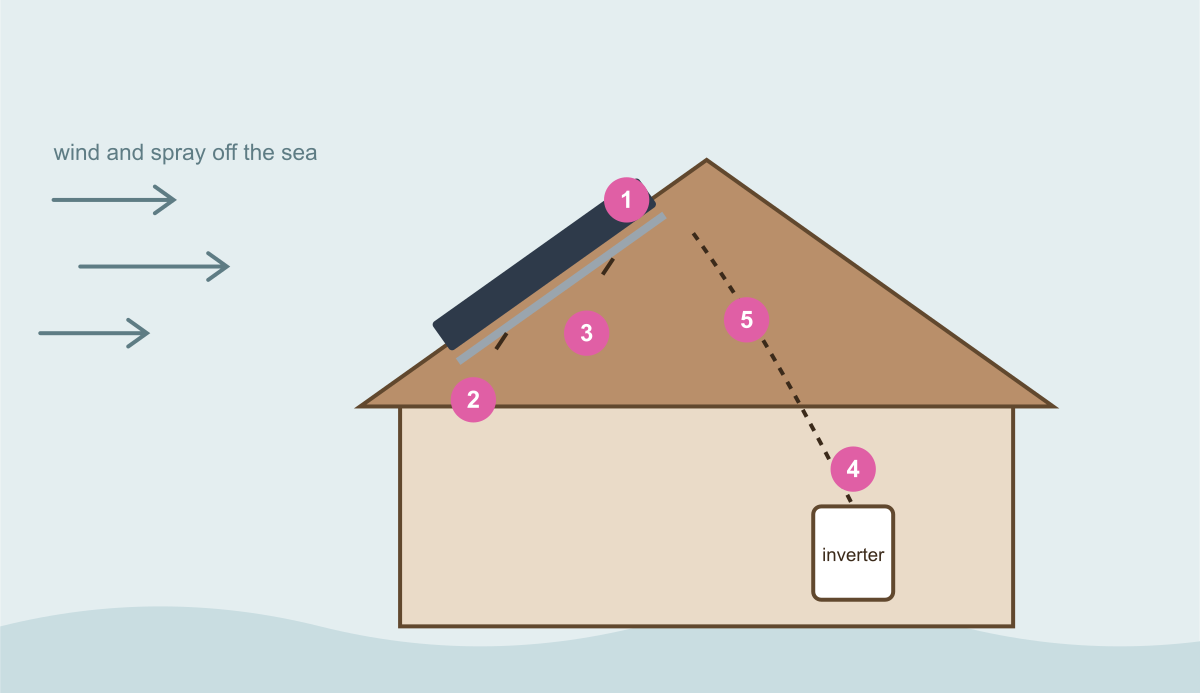
1. Panels that have been tested for salt
Salt carried on the wind settles on frames, junction boxes and connectors. Over years it can corrode them, and moisture getting into a panel's edges is how output is lost. The international test for this is IEC 61701, a salt-mist corrosion test for solar panels. It has several severity levels: severity 1 is the one intended for panels used in a marine environment or close to the sea, while the higher numbers are written for places where de-icing salt is the concern.
Most panels sold in the UK list their test certificates on the datasheet. If you live within sight of the open sea, ask the installer which salt-mist test and severity the proposed panels passed, and keep the datasheet with your paperwork. A panel that has not been tested is not necessarily bad, but you will not know how it behaves on your roof until it is too late to choose another.
2. Rails, clamps and screws that will not rust
The panels sit on aluminium rails held by clamps and roof hooks. On the coast the metals and how they touch matter. Anodised aluminium rails and stainless steel fasteners resist salt air; plain or poorly galvanised steel parts rust, and two different metals in direct contact can corrode each other faster in a damp, salty atmosphere. Ask what grade of stainless the bolts are and whether the kit maker approves its use near the sea.
It is also worth asking how the hooks pass the tiles or slates. On Wirral's many pre-1945 roofs, slates and old tiles crack easily, and a broken slate under a panel is a leak you will not see until the ceiling stains.
3. A roof kit rated for the wind
A peninsula with sea on three sides gets wind from every direction. In Britain, pitched-roof mounting kits are certified under MCS 012, which tests them for wind uplift and weathertightness, and the kit's certificate states the design wind-uplift resistance it achieved and the roof pitches it suits. MCS installers design systems to the solar installation standard, MIS 3002, whose current version (6.0) was issued in March 2026.
The useful questions are simple. Is the mounting kit MCS 012 certified, and can I see the certificate? What wind load did you work out for my roof, and how does it compare with the kit's rating? Are panels kept back from the roof edges and ridge, where wind lifts hardest? A careful installer will have the answers on paper.
4. The inverter out of the weather
The inverter turns the panels' direct current into the alternating current your home uses. It is the part most likely to need replacing during a system's life, and it lasts longest somewhere dry and ventilated. On a seafront house that means a loft, garage or utility room rather than an outside wall facing the sea. The same goes for any battery: keep it inside unless it is specifically rated for outdoor coastal use.
5. A sealed route for the cables
Cables from the panels need to enter the roof through a proper sealed fitting, not under a lifted tile, and they should be clipped so they cannot rub in the wind. Driving rain off Liverpool Bay will find any gap. Ask to see where the cables will run before work starts.
Sand, gulls and cleaning
Along the north coast, onshore winds lift sand from the beaches and dunes. A film of sand and salt on the glass cuts output a little until rain washes it off, and panels at a low tilt clean themselves less well than steeper ones. Gulls are the other coastal nuisance: they perch on ridges, drop shells and droppings on the glass, and pigeons and gulls sometimes nest in the gap under a panel. Bird mesh fitted round the edge of the array keeps them out and is easier to add at installation than later. Our care and cleaning guide covers when and how to clean, and why a pressure washer is a bad idea.
A checklist to take to your quotes
| Question | Open coast | Dee estuary | Mersey side |
|---|---|---|---|
| Salt-mist test (IEC 61701) on the datasheet | Essential | Worth asking | Worth asking |
| Stainless fixings, anodised rails | Essential | Essential | Advisable |
| MCS 012 kit certificate and wind-uplift figure | Essential | Essential | Essential |
| Inverter and battery indoors | Essential | Advisable | Advisable |
| Bird mesh round the array | Advisable | Optional | Advisable near the docks |
| Cleaning plan for sand and salt | Advisable | Optional | Optional |
Our own grading of the questions by exposure, not a regulation. Ask about all of them wherever you live.
Planning on the seafront
Coastal streets are not treated differently in planning law: roof panels on a house are normally permitted development. But several of Wirral's conservation areas are on the coast, among them Meols Drive and The King's Gap in Hoylake, West Kirby, and The Magazines in Wallasey. In those, panels may not go on a wall or balcony facing the road without permission, and roof panels should be sited to keep their effect on the street small. The conservation areas guide lists all 26.
Insurance and paperwork
Tell your home insurer before the panels go on; most simply note them, but some want details of the installer and the kit. Keep the MCS certificate, the panel and kit datasheets, the wind-load figure and the installer's warranty together. If anything fails in a storm, those papers are what a claim turns on.
Read next
Sources for this page
- MCS standards and tools library (MIS 3002, MCS 012)
- Wirral Council: Wirral Spatial Portrait 2020 (local plan evidence, draft)
- The Town and Country Planning (General Permitted Development) (England) Order 2015, Schedule 2, Part 14
- Energy Saving Trust: solar panels
- MCS: find a certified installer
Figures were read at these sources on 3 November 2026. Spotted something out of date? Tell us through the form below.