Wirral's housing in numbers
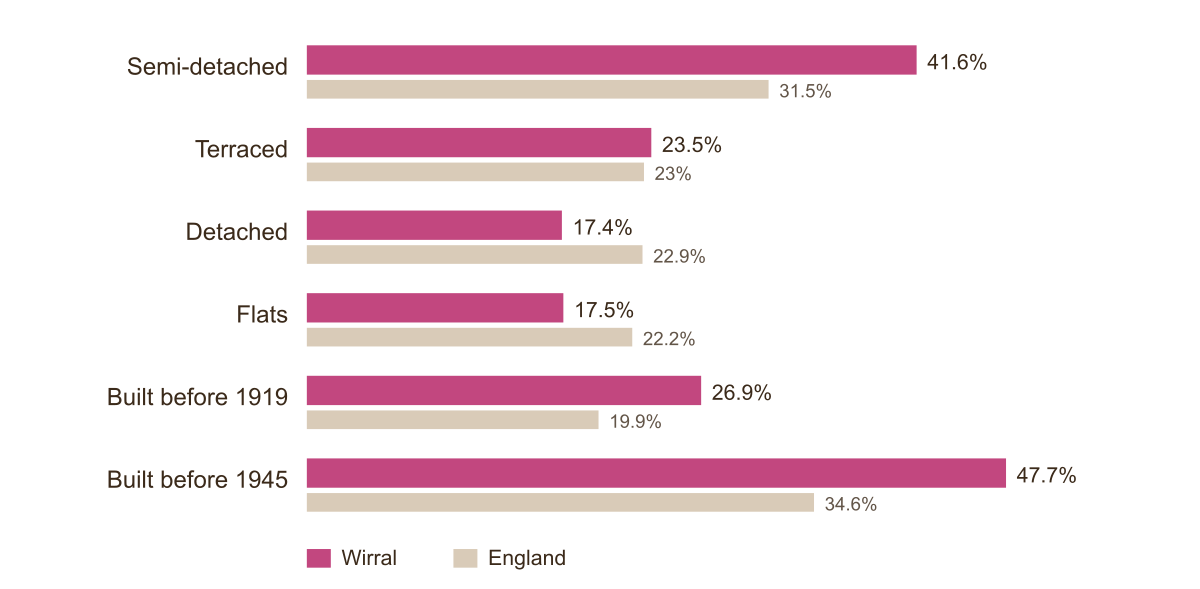
| Measure | Wirral | England | Source |
|---|---|---|---|
| Households | 143,252 | – | Census 2021 |
| Semi-detached house | 41.6% | 31.5% | Census 2021 |
| Terraced house | 23.5% | 23.0% | Census 2021 |
| Detached house | 17.4% | 22.9% | Census 2021 |
| Flat or maisonette | 17.5% | 22.2% | Census 2021 |
| Owned (outright or with a mortgage) | 65.0% | 61.3% | Census 2021 |
| Private rented | 18.9% | 20.5% | Census 2021 |
| Built before 1919 | 26.9% | 19.9% | VOA 2026 |
| Built before 1945 | 47.7% | 34.6% | VOA 2026 |
| Built 2009 or later | 5.3% | 12.6% | VOA 2026 |
| Bungalows | 7.8% | 9.0% | VOA 2026 |
| EPC rated A to C (homes with an EPC) | 44.3% | 53.3% | ONS, EPCs lodged 2015–2025 |
Census figures count households; VOA figures count dwellings on the Council Tax list (152,700 in Wirral). Figures checked 3 November 2026.
Three things stand out. Wirral is semi-detached country, with ten points more semis than England. It is old: the VOA count shows nearly half its homes went up before the Second World War and only 5.3% in 2009 or later, under half the English share. And it is owner-occupied: 65.0% of households own their home, which matters because owners can decide on panels without asking anyone. The borough already had 5,382 solar installations at the end of 2025 by the government's count, up from 1,778 in 2014.
Victorian and Edwardian terraces
The council's own planning evidence describes densely built terraces from the early 1900s around the Birkenhead Dock Estate and in central Birkenhead and Tranmere. VOA's count puts 11.5% of Wirral's homes in the years 1900 to 1918 alone, more than twice England's 5.0%.
- Roof: usually one main slope to the front and one to the back, often with a rear outrigger (the narrow back extension) that has its own small roof. Natural slate is common.
- What fits: about 2 to 4 kW on the better-facing main slope. The outrigger roof can take a few panels but is often shaded by the house itself.
- Check first: chimney stacks shading the panels, the condition of the slates and battens, and whether a neighbour's chimney shades the layout. Ask how the hooks will pass the slate.
Victorian and Edwardian villas
Along the ridge through Oxton, Claughton, Prenton and Bidston, and in the merchant estates such as Rock Park, larger nineteenth-century houses stand in bigger plots. Several of these streets are conservation areas, and some houses are listed.
- Roof: steep, often complex, with gables, dormers and tall chimneys; often three storeys high.
- What fits: 3 to 6 kW where a large rear slope faces south, east or west.
- Check first: listed status, conservation area rules for walls facing the road, and scaffolding costs for the height. See conservation areas.
Interwar and post-war semis
Homes built from 1919 to 1939 make up 20.8% of the stock against 14.7% in England, and the council's evidence describes large post-war suburbs in Leasowe, Moreton, Greasby, Pensby, Woodchurch and Eastham. Together these semis are the most common home on the peninsula and the most common solar roof.
- Roof: 1930s semis often have a hipped roof, which slopes down at the side as well as the front and back; many post-war semis have a simple gable with two full slopes.
- What fits: about 3 to 4 kW on a hipped roof's main slope, 3 to 5 kW on a gable roof, or an east–west split on both slopes.
- Check first: the hip cuts the usable space, so ask for a layout drawing. EPC records suggest Wirral's semis are the least efficient type: only 29.3% of those with an EPC are rated C or better, so loft and wall insulation may be worth doing alongside.
Detached houses
17.4% of Wirral households live in a detached house, fewer than in England. The council's planning evidence picks out the later, lower-density residential areas of Caldy, Heswall, Hoylake and Mountwood, and the west of the peninsula is also its sunnier half on our map.
- What fits: 4 to 6 kW or more on a good slope, plus a garage roof.
- Check first: whether a larger system needs the network operator's approval under G99, whether the supply is single or three phase, and trees in a mature garden.
Bungalows
Wirral has fewer bungalows than you might expect: 7.8% of homes against 9.0% in England, and about half of them have two bedrooms (VOA). Their roofs are low and wide, which makes installation simpler and cheaper, but they are easily shaded by neighbouring houses, hedges and trees. A low roof is also easier for a gull to reach and easier for you to keep an eye on.
Flats
17.5% of Wirral households live in a flat: 11.9% in purpose-built blocks and 3.9% in converted or shared houses, with the rest in other converted buildings or above shops. A flat owner usually does not control the roof: the freeholder or management company does, and any roof array is a building-wide decision. Since 27 August 2026 there is a smaller option: plug-in solar devices of up to 800 watts, which can go on a balcony or wall subject to rules. See flats and plug-in solar.
Renters and landlords
Private renting has grown on the Wirral, from 15.8% of households in 2011 to 18.9% in 2021. Tenants need the landlord's agreement for panels. Landlords of homes rated EPC D to G may be able to use the Warm Homes: Local Grant for tenanted homes where the tenants qualify; under the national rules a landlord's first property needs no contribution and further properties need a 50% contribution; see grants and funding.
What older homes should do first
On a pre-1945 roof, ask the installer, or a roofer before them, to look at the roof covering and battens before agreeing a price. Re-roofing later means taking the panels off and putting them back. The roofing work is charged at the standard VAT rate, while the solar installation is zero-rated until 31 March 2027, so a quote should show them separately. And because only 44.3% of Wirral homes with an EPC are rated C or above, against 53.3% in England, insulation may cut your bills as much as panels do; doing both is better than either.
Read next
Sources for this page
- Census 2021 TS044, accommodation type (Nomis)
- ONS: how life has changed in Wirral, Census 2021
- VOA: Council Tax stock of properties 2026
- ONS: energy efficiency of housing in England and Wales (EPC band C or above by area)
- DESNZ: renewable electricity by local authority, 2014 to 2025
- Wirral Council: Wirral Spatial Portrait 2020 (local plan evidence, draft)
- HM Land Registry: UK House Price Index for Wirral
- Liverpool City Region Combined Authority: Warm Homes: Local Grant
Figures were read at these sources on 3 November 2026. Spotted something out of date? Tell us through the form below.